Before You Change Your Infrastructure, Make Sure You Know What You're Changing.
Infrastructure complexity rarely appears overnight. It accumulates through years of change, expansion and undocumented dependencies.
Before the next migration, investment or major change, some questions become important:
- What depends on what?
- What can safely change?
- Who owns it?
- And what are you assuming simply because everyone else has?
An independant infrastructure audit replaces assumptions with evidence, so you can make the next decision with greater confidence.
PURPOSE OF AN INFRASTRUCTURE AUDIT
An Audit Should Answer the Questions You Can't Afford to Guess At.
An infrastructure audit establishes what exists, how it is structured, where critical dependencies sit and whether governance reflects operational reality.
The objective is not to produce another technical inventory but to give leadership a reliable basis for deciding what can remain, what needs attention and what can safely change.
The good audit should answer:
1
What do we have, and how does it fit together?
2
Where are the dependencies we cannot afford to discover halfway through a project?
3
Who owns the critical systems, decisions and risks?
4
What happens if a critical system, supplier or individual becomes unavailable?
5
Where are complexity, duplication or legacy decisions creating unnecessary exposure?
6
What needs attention now, and what can wait?
Scope of review
Understand the Environment as a System, Not a Collection of Components.
Every audit is adapted to the organisation, its operating model and the questions leadership needs answered.
The review typically covers five interconnected areas.
01 Core Infrastructures
We assess whether the foundations of the environment remain coherent, resilient and appropriate for current operational requirements.
This may include:
- Server environments, on-premise and hybrid
- Cloud foundations and configuration modelsy
- Virtualisation and storage layers
- Backup and recovery architecture

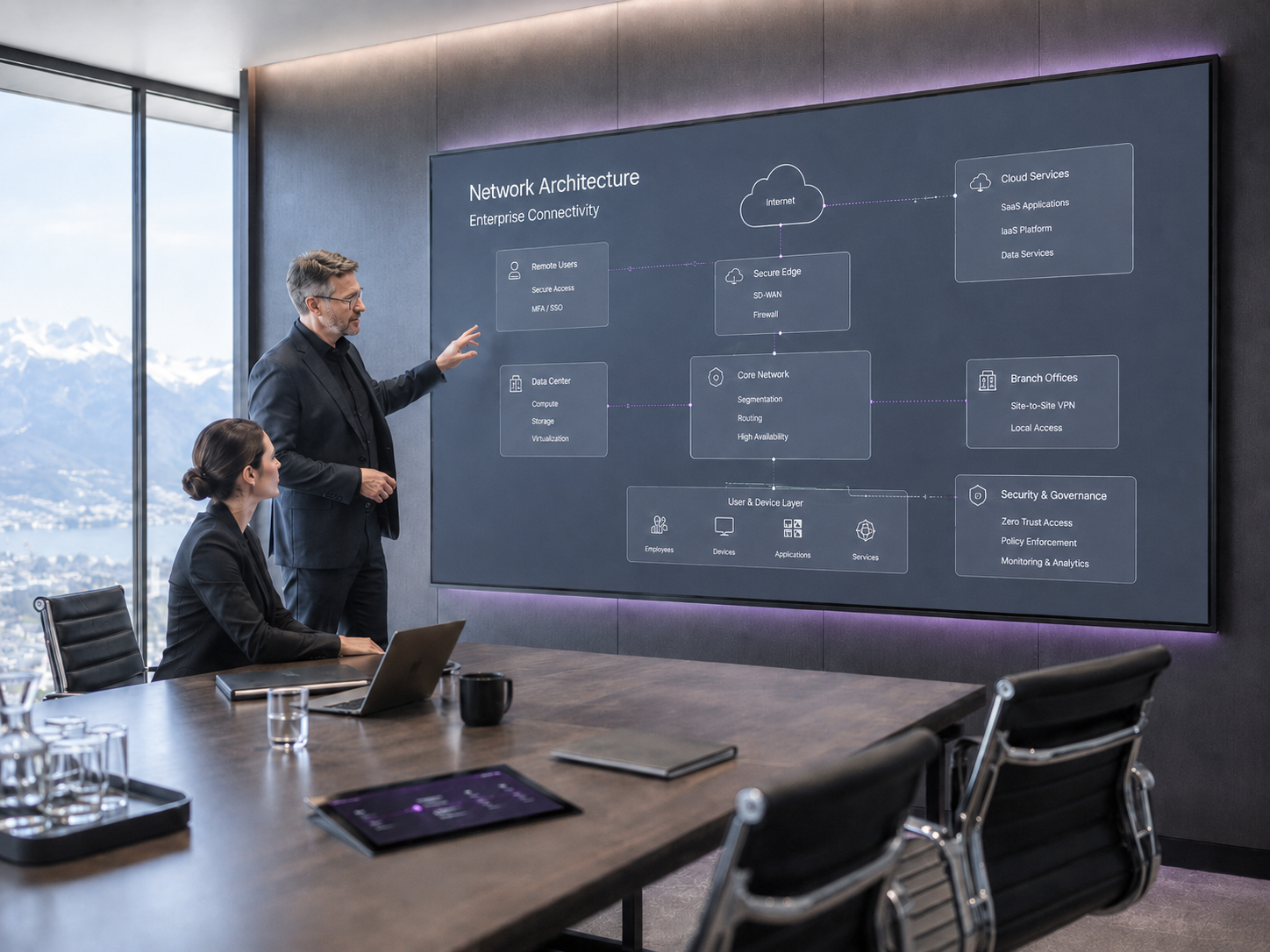
02 Network Architectures
We review how systems, users and locations connect, and whether the architecture provides appropriate segmentation, control and resilience
This may include:
- Segmentation models
- Firewall structure and perimeter controls
- Connectivity between sites
- Remote access governance
03 Identity & Access Governance
We assess whether access reflects defined responsibilities and whether privileges, identities and authentication controls are structured consistently.
This may include:
- Active Directory and identity architecture
- Privilege structures
- Role-based access models
- Multi-factor authentication alignmenton


04 Device & Endpoint Governance
We review how endpoints are managed throughout their lifecycle and whether configurations and security practices remain consistent across the environment.
This may include:
- Lifecycle control
- Patch management discipline
- Configuration standardisation
- Security posture consistency
05 Operational Continuity
We assess whether the organisation has sufficient documentation, ownership and operational knowledge to maintain continuity through change, disruption or supplier transition.
This may include:
- Infrastructure documentation quality
- Escalation models
- Vendor dependency exposure
- Business continuity alignmenti

SWISS REGULATORY CONTEXT
Infrastructure Decisions Increasingly Have Governance Consequences.
For organisations operating in Switzerland and Europe, infrastructure is not purely a technical concern.
Data protection, access governance, accountability, documentation and continuity increasingly intersect with broader governance and regulatory expectations.
Relevant considerations may include:
- Data protection under the nFADP and GDPR
- Documentation and traceability
- Access governance
- Defined accountability structures
- Business continuity planning
An infrastructure audit is not a legal or regulatory compliance review, but architectural weaknesses frequently intersect with regulatory exposure.
We assess infrastructure resilience with awareness of the Swiss and European regulatory environments and the governance expectations surrounding it.
The value of an independent view
Before a Major Change Is the Best Time to Find the Problems.
Infrastructure issues are expensive when they surface halfway through a migration, supplier transition or major technology project.
Typical situations include:
Before a Cloud Migration
Understand dependencies, workloads, and design constraints before moving systems to the cloud.
Before a Major Infrastructure Investment
Validate the investment and that the spending addresses real needs.
Before an Acquisition, Integration or Expansion
Changes often leave behind overlapping systems, suppliers and old ways of working

Infrastructure Costs Keep Increasing
Leadership wants to know what can be consolidated, simlified or retired.
When Recurring Incidents Suggest Deeper Issues
Identify underlying architectural or operational problems before more incidents occur.
Early visibility creates options. Later, it creates constraints.
Evidence First.
Recommendations Second.
Our audit process follows a defined structure designed to move from understanding the environment to prioritising what should happen next.
01
Context & Objectives
Clarify the organisational context, business priorities, concerns and decisions the audit needs to support.
02
Architecture Review & Validation
Review the architecture and sample relevant configurations to establish how the environment is actually structured and operated.
03
Risk & Dependency Mapping
Identify structural risks, critical dependencies and areas where complexity or insufficient visibility may create operational exposure.
04
Governance & Ownership
Validate responsibilities, decision-making structures, ownership and accountability across the environment.
05
Findings & Priorities
Translate technical findings into structured, prioritised recommendations based on risk, operational impact and practical value.
06
Executive Summary & Accountability
Provide leadership with a clear view of the findings, priorities, dependencies and ownership required to move forward.
FROM VALIDATION TO ACTION
The Audit Doesn't Have to End With a Report.
Some organisations need independent validation only.
Others need support turning the findings into action.
Where required, we can help translate recommendations into structured remediation planning, governance improvements or phased implementation while preserving the architectural context established during the audit.
This can include:
- Remediation planning and prioritisation
- Governance and ownership reinforcement
- Documentation improvement
- Architecture and infrastructure roadmapping
- Coordination of phased technical improvements
- Ongoing senior-level advisory support
The objective is continuity between understanding the problem and resolving it, without turning the audit into an excuse for unnecessary change.
Validation should simplify the path forward, not create another layer of complexity.
Before Your Next Major IT Decision, Make Sure You Know What You're Deciding On.

Understand what you have
Gain a clear view of your infrastructure, dependencies and risks.

Make informed decisions
Move forward with confidence, or identify what needs to change.

Reduce risk and exposure
Strengthen governance, security, and operational resilience.

Create a practical path forward
Prioritized recommendations that align with your goals and resources.
An independent infrastructure audit gives you the clarity, confidence, and control to move forward, or to pause.
Start with a conversation with us.
We'll discuss your environment, priorities, and what matters most to you.
Understand what you have
Gain a clear view of your infrastructure, dependencies and risks.
Make informed decisions
Move forward with confidence, or identify what needs to change.
Reduce risk and exposure
Strengthen governance, security, and operational resilience.
Create a practical path forward
Prioritized recommendations that align with your goals and resources.